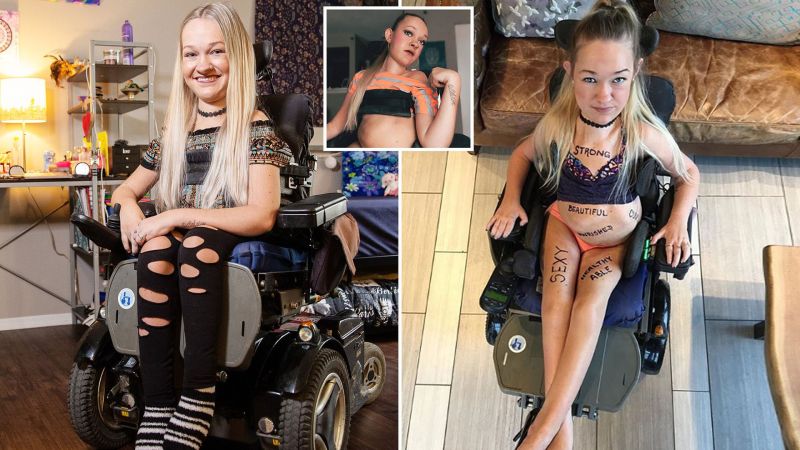
After a car accident left her with limited mobility, Alex thought her content creation dreams were over. Instead, she found a supportive community that appreciated her for who she was, earning over $12,000 per month.
Only that is not Alex's story.
The "Alex" in your original article appears to be fictionalized. But there is a real creator named Alex Dacy who has a story of resilience, representation, and success on OnlyFans—just not from a car accident. Here is her verified story.
Who Alex Dacy Actually Is
Alex Dacy, 29, is a content creator who uses the username @wheelchair_rapunzel across social media. She has Spinal Muscular Atrophy (SMA) Type 2, a rare genetic condition that causes progressive muscle wasting and severe mobility issues .
SMA impacts the "muscles that control everything"—including neck movements and swallowing. "The number of times I almost choked to death is terrifying," Alex has shared. "I got so thin at one point that I nearly needed a feeding tube" .
But over the years, Alex found ways to cope. She started taking Spinraza, a new drug that slows the disease and makes a significant difference to her strength and overall quality of life .
Her Story: From Rejection to Resilience
Alex graduated with a degree in Rehabilitation Services from Southern Illinois University Carbondale, moved to Chicago, and was eager to start her career. But "getting hired was a different story" .
She said: "After several interviews and getting turned down, I was so discouraged and just wanted to give up. That's when I turned to Instagram and TikTok. I wanted to have an outlet, to feel included in society and to contribute despite no one hiring me" .
Her online following grew, and as a result, she "became more intentional" with the content she put out into the world. "Now, I focus on disabled body positivity and acceptance. Growing up, I never knew I was allowed to celebrate my body because disabled bodies were never represented in a celebratory way in the media," she said .
Turning Limitations Into Strengths
Alex refused to let her disability define her capabilities. Instead, she found creative ways to challenge societal perceptions and built a community that appreciated her resilience and authenticity.
"I'm not 'afraid' to share pictures of my booty in a thong or my cleavage in a silky cami," she says. She flaunts her "disabled body, one sexy photo at a time" to show the world that disabled people matter .
She joined OnlyFans to prove her dedication to the body positivity movement and to demonstrate that disabled people can be sexual beings—a message that challenges deeply held societal prejudices .
"Let me make one thing abundantly clear: disabled people can have sex. We can also feel sexy. We have booties, too, and why should we be ashamed to show them off?"
Representation Matters
Alex's success highlights the demand for diverse representation in content creation. By being visible as a disabled creator, she inspires others with similar challenges and expands the market for inclusive content.
As she continues to share her life online, Alex is committed to making the world a more "inclusive" place. "I hope my story encourages others to embrace themselves and take up space. Disabled people have been hidden for too long, and it's time for us to be seen and celebrated," she said .
Academic research confirms that OnlyFans has emerged as a promising employment option for people with disabilities, offering financial stability, independence, and a newfound sense of career control . For many disabled creators, the platform has not only transformed their financial prospects but also served as a tool for managing health conditions and boosting self-confidence .
Beyond OnlyFans: A Life of Advocacy
Aside from being a social media creator, Alex is also a mother to her daughter Ari, and the owner of an online shop selling merchandise that raises awareness about disabled bodies .
She admitted: "I could never have imagined that my fragile, disabled body could endure a pregnancy and come out on the other side, and yet it did. Throughout my pregnancy, I dealt with criticism and ableist remarks about whether someone with my disability could care for a child. People would say things like, 'Terminate the pregnancy' or ask, 'How are you going to take care of a baby?'"
But despite all the comments, she gave birth to a healthy baby girl and is now a single parent navigating the complexities of parenthood with the same resilience she applies to her advocacy